
The Eight Precepts are a traditional Buddhist framework for ethical restraint, mindfulness, simplicity, and renunciation. They are often undertaken by lay Buddhists during meditation retreats, Uposatha observance days, or other periods of intensified practice.
But the Eight Precepts can offer something more than a temporary list of rules.
Each precept invites us to examine an area of life that can become shaped by craving, attachment, aversion, habit, or distraction. The practice is not simply about asking, “What am I forbidden to do?” It is also about asking deeper questions:
- What is the intention behind this precept?
- What does it reveal about my own habits and attachments?
- What qualities might I cultivate instead?
- And what would it look like to design my life so that those qualities become easier to live?
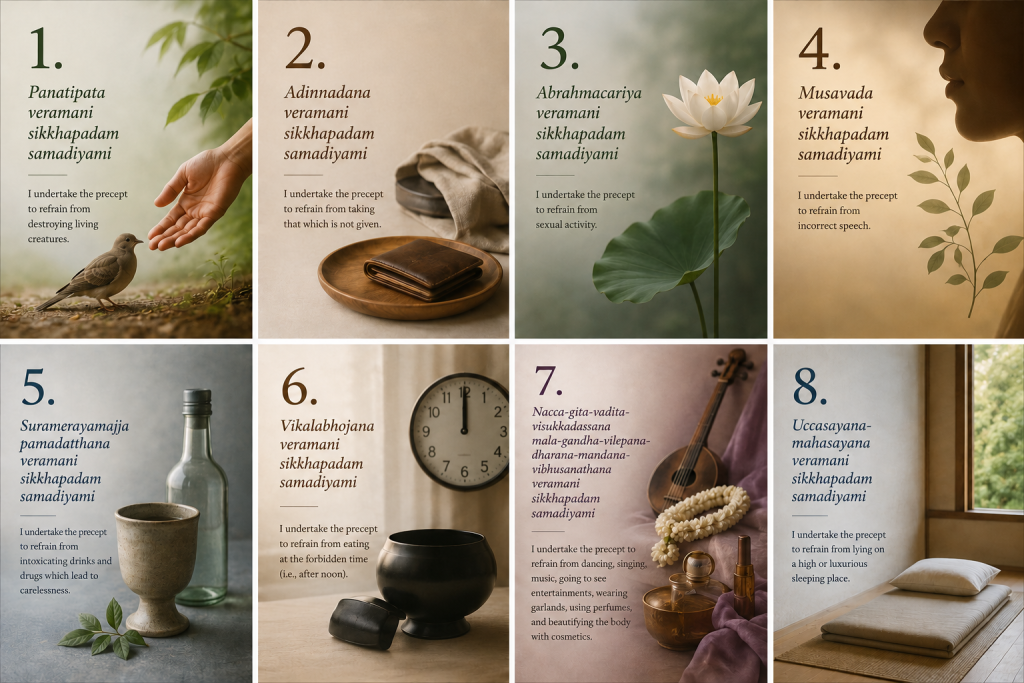
The Eight Precepts
- Abstain from Killing Any Being
(pānātipātā veramaṇi sikkhāpadaṃ samādhiyāmi) - Abstain from Stealing
(adinnādānā veramaṇi sikkhāpadaṃ samādhiyāmi) - Abstain from All Sexual Activity
(abrahmacariyā veramaṇi sikkhāpadaṃ samādhiyāmi) - Abstain from Telling Lies
(musāvādā veramaṇi sikkhāpadaṃ samādhiyāmi) - Refrain from Intoxicating Drinks and Drugs
(surāmeraya majjapamādaṭṭhānā veramaṇi sikkhāpadaṃ samādhiyāmi) - Abstain from Eating After Noon Time
(vikāla bhojanā veramaṇi sikkhāpadaṃ samādhiyāmi) - Abstain From Sensual Entertainment And Bodily Decorations
(nacca gīta vādita visukadassanā mālā gandha vilepana dhārana mandana vibhūsanaṭṭhānā veramaṇi sikkhāpadaṃ samādhiyāmi). - Abstain From Using High Or Luxurious Beds
(uccāsayana mahāsayana veramaṇi sikkhāpadaṃ samādhiyāmi)
More Than Rules
The traditional wording of the precepts emphasizes restraint: abstain, refrain, do not engage.
Restraint matters. It creates space between an impulse and an action. It allows us to notice habits that might otherwise operate automatically.
But restraint is only one way to approach the Eight Precepts.
Each precept can also point toward an aspirational quality:
- Refraining from killing can become compassion and reverence for life.
- Refraining from stealing can become generosity and contentment.
- Refraining from sexual activity can become integrity, mindfulness, and care in relationships.
- Refraining from false speech can become truthful, kind, and meaningful communication.
- Refraining from intoxicants can become clarity and mindful awareness.
- Refraining from eating after noon can become mindful nourishment and balance.
- Refraining from sensual entertainment and adornment can become simplicity and inner joy.
- Refraining from luxurious sleeping arrangements can become humility, contentment, and ease with less.
Seen this way, the precepts are not simply restrictions. They become opportunities to examine how we live and what we want to cultivate.
Exploring the Grey
The Eight Precepts sound simple when presented as a list.
Living them is considerably more complicated.
Does taking medication that affects consciousness violate the Fifth Precept? What about cannabis used medicinally? Psychedelics used intentionally? Is listening to music always contrary to the Seventh Precept, or does intention matter? Is sleeping in a comfortable bed necessarily indulgence? How should someone approach the Sixth Precept when health, work schedules, or family life complicate eating before noon?
There may not be one universal answer to every modern situation.
The more useful practice may be to examine intention, attachment, consequences, and the effect a choice has on the mind.
The question becomes less:
“Did I technically break the rule?”
and more:
“What is happening in my mind, what am I cultivating, and does this choice move me toward or away from the kind of life I want to live?”
Practice Context
The Eight Precepts have traditionally been associated with periods of more intensive practice. Lay practitioners may undertake them during Uposatha observance days, meditation retreats, or another intentionally chosen period.
A temporary vow can be powerful precisely because it is intentional. Choosing to live differently for a day, a weekend, or the duration of a retreat makes habitual patterns more visible.
But the insights do not have to end when the formal observance ends.
A practitioner might discover that eating more intentionally improves clarity, that reducing entertainment quiets the mind, that simplifying possessions reduces craving, or that greater attention to speech changes relationships.
The literal precept can therefore become the starting point for examining how its underlying principle might influence everyday life.
Intention Matters
The precepts are not only about outward behavior.
Two actions that appear similar can arise from very different intentions. Likewise, following a rule mechanically while cultivating resentment, pride, judgment, or attachment may miss much of what the practice is intended to reveal.
This is why the Eight Precepts are useful as training.
They encourage us to notice not only what we do, but also why we do it.
What am I seeking?
What am I avoiding?
What am I attached to?
What happens when I do not immediately satisfy that desire?
What happens to my mind when I choose differently?
Those questions can transform a simple rule into a meaningful spiritual practice.
Five, Eight, and Ten Precepts
The Five, Eight, and Ten Precepts represent different levels and contexts of Buddhist ethical training.
The Five Precepts provide a foundational ethical framework for lay Buddhist life.
The Eight Precepts retain those foundations while introducing additional practices of restraint and renunciation. The third precept also changes from refraining from sexual misconduct to refraining from sexual activity.
The Ten Precepts are commonly associated with novice monastic practice and extend renunciation further.
| Behavior | Five Precepts | Eight Precepts | Ten Precepts |
| Killing, Stealing, Lying, Intoxicants | Prohibited | Prohibited | Prohibited |
| Sexuality | No sexual misconduct (adultery, coercion) | Strict celibacy | Strict celibacy |
| Eating | No restriction | Fasting after solar noon | Fasting after solar noon |
| Entertainment & Cosmetics | No restriction | Prohibited (Grouped as 1 rule) | Prohibited (Split into 2 rules) |
| Sleeping Quarters | No restriction | No high or luxurious beds | No high or luxurious beds |
| Wealth | No restriction | No restriction | No handling gold, silver, or money |
Rather than thinking of these simply as increasingly severe sets of rules, it can be helpful to see them as different structures for practice. Each creates conditions that encourage practitioners to examine desire, attachment, conduct, and the workings of the mind.
From Restraint to Aspiration
There is an important difference between building a life around what you are trying not to do and building one around what you want to cultivate.
“Do not lie” can become:
Speak truthfully, kindly, and meaningfully.
“Do not become intoxicated” can become:
Cultivate clarity and presence.
“Do not indulge in entertainment” can become:
Discover contentment without constant stimulation.
“Do not seek luxury” can become:
Find ease in simplicity and enoughness.
The restraint remains, but it serves something larger.
The Eight Precepts can become a framework for asking a much more interesting question: How do I want to live?
Making the Precepts Your Own
There is a great deal of grey area in applying teachings developed in another time and culture to modern life.
That is not necessarily a problem.
It is an invitation to investigate.
Rather than accepting someone else’s interpretation without reflection, explore each precept carefully. Consider the traditional restraint. Examine your intentions and reactions. Look at the consequences of your choices. Identify the quality or virtue that the precept points toward.
Then decide how you want that understanding to influence your life.
The goal is not perfection.
The goal is greater awareness, less reactivity, greater clarity, and a way of living that reduces suffering for yourself and others.
The precepts do not have to become chains.
Properly explored, they can become tools for liberation.